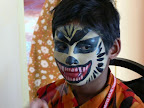
Enamul Haq, aged 8, younger brother of Nazmul Hasan (TDP student) had a serious burn injury.
While Enamul was in his room the electrical wires caught fire and he was burned instantly on right side of his face, hand and leg.
He was immediately brought to The Dhaka Project Medical Centre where he was provided first-aid treatment.
Later he was referred to the Dhaka Medical College Hospital Burn Unit where he is undergoing a treatment from May 07, 2010.
All the medical expenses are provided by The Dhaka Project.
Showing posts with label Dhaka Reality. Show all posts
Wednesday, June 9, 2010
Saturday, July 5, 2008
JENNA'S JOURNAL - WEEK 1
I have been here for just over a week. Most of these days have been filtered with exhaustion, heat, extreme fluid loss and a cacophony of new places, names and tastes. I have been teamed up with the family counsellor, Faria, with 2 objectives. Firstly, task is to assist in enhancing the communication channels between the counsellor and the other staff members. The information that Faria receives from the families is vital to understanding the pressures that impact on the individuals and community every day. It is essential that this information is relayed back to appropriate TDP sectors so that firstly, these issues are made aware of and secondly, so that change can be implicated where necessary. The second task is to write articles to the newspapers, from a micro-perspective, elucidating what these pressures (i.e. food and rent costs) are and how these pressure impact upon the family and the broader community. It is not enough to keep this information contained within The Dhaka Project community. Problems need to be quantified and greater awareness is necessary for change.
Bite the hand that feeds...
I have only been here a short while but I have seen so much positive and proactive work put in by the volunteers and staff here at TDP: teacher development programs, a new medical clinic (with an additional doctor!), micro-credit trials and although in it’s embryonic stages, the setting in motion of a TDP garment and/or craft factory and point-of-sale venture. However this was all (unfortunately) overshadowed by a community meeting that I attended a few days ago. Below is a copy of an email i sent to a friend:
Jenna Dennison
Bite the hand that feeds...
I have only been here a short while but I have seen so much positive and proactive work put in by the volunteers and staff here at TDP: teacher development programs, a new medical clinic (with an additional doctor!), micro-credit trials and although in it’s embryonic stages, the setting in motion of a TDP garment and/or craft factory and point-of-sale venture. However this was all (unfortunately) overshadowed by a community meeting that I attended a few days ago. Below is a copy of an email i sent to a friend:
“I have just return from a community meeting. All of it was in Bangla so I couldn't understand it obviously but it was the most interesting thing I have seen since being here. When I arrived there must have been about 100 local women (the mothers and grandmothers of students of TDP) all sitting on the floor on one side and the men sitting in another group. TDP staff were all standing up the front talking about the issues facing them and the community. Although it was all delivered in Bangla there did not appear to be organisation or structure to the meeting (or even within the staff themselves). Although it was evident that they were all ‘singing to the same tune’ it was not evident who was in charge. The tone of the meeting ranged from unanimous applause from the crowd to yelling and violent hand gestures from the staff. There was a sense of desperation. A reciprocated desperation. I was sitting up the back with another volunteer, Georgie, and the women were crowding around us with there babies and children asking us (in Bangla) to solve their problems (having absolutely no idea what was actually being said). I couldn’t figure out if I was the enemy or a miracle worker. Fragile relationships...There are so many issues here. TDP encourages the children to attend school on a daily basis however this seems to run anathema to the lifestyles of many people in the community. From my (limited) understanding, it appears that families move to Dhaka to make money and move back to their rural villages when the expense of Dhaka living exceeds their means of living. However, this nomadic lifestyle is challenged by the ethos of TDP whose emphasis is the continual education of the children. Using the children as leverage the parents are able to ‘bribe’ TDP for rent claiming that they will be unable to feed, cloth and continue the child’s education if the family is not supported through the means of rent assistance or employment assistance. It is understandable to acknowledge that if one family receives assistance (with the reasons not always clear or transferable) then other families will also want the same benefits. So how is it that TDP can put the education of children of the slums at the forefront of their initiative yet still support the families that support the children? Has the drive for education been lost amongst the demands of the community? Is it possible to remove this relationship altogether? The children need to be the priority and thankfully wonderful TDP staff, teachers, and enthusiastic volunteers are trying to make this, once again, the emphasis of the project.
It was just so heated. The project is supposed to be about educating the poorest of the poor by providing them with both knowledge and nutrition, but it has become a community project where people just want hand outs. Given an inch they take a mile, but you can not blame them because in the beginning it was that way. No processes, no transparency but a quick fix. So now 38 families receive rent money and another 43 want rent money. If there has been no transparent criteria as to why the first 38 receive rent then why should these additional 43 not be entitled? That is the argument. There has been no transparency previously in this process, no justification for why some people have their rent paid for and why others not.... It is our duty to establish a transparent criteria or abolish rent assistance altogether.
It was intense, but the most honest I have seen since being here... tenuous paths to walk...”
Jenna Dennison
GEORGIE'S JOURNAL - WEEK 1
Arriving in Bangladesh was quite the clichéd “culture shock”. Having been to parts of Africa and Asia I thought I had a rough idea of what I was in for, but Bangladesh is in a league of its own. If you ever want to feel like a celebrity, come to Bangladesh! The area in which the project is based is generally untouched by tourism and seeing a “bedeshi” or foreigner hanging onto a rickshaw like their life depends on it must be very amusing for the locals.
My first impression of the Dhaka Project was walking down the dirt road to the school and office being followed by kids asking in perfect English, “how are you, what is your name?” quite a remarkable thing for a place with minimal Western influence. I am spending just under a month with the Dhaka Project, aiming to develop criteria for the giving of rent money to the community.
Previously, rent assistance has been handed out in an ad hoc manner based on need, and this is beginning to cause problems within the community; the Dhaka Project counselor becoming increasingly swamped with requests for rent payments. So far, I have visited families in the community to see the conditions in which they live, talk to families about their problems and talk directly to the school children about their family situations. Visiting Bangladesh in the monsoon period is generally difficult, but for families living in already substandard conditions, floods and heavy rain can be devastating; making homes unlivable and promoting the spread of water borne disease.
After visiting some community houses, determining criteria for rent assistance becomes problematic as it is difficult not to think that all families need help! However, the motive of the Dhaka Project is foremost to educate the children of Dhaka; any further assistance given to the community being sustainable for the project and the families. It will be a challenging task, but one that will hopefully make the job of the counselor easier and provide certainty for the community.
My first impression of the Dhaka Project was walking down the dirt road to the school and office being followed by kids asking in perfect English, “how are you, what is your name?” quite a remarkable thing for a place with minimal Western influence. I am spending just under a month with the Dhaka Project, aiming to develop criteria for the giving of rent money to the community.
Previously, rent assistance has been handed out in an ad hoc manner based on need, and this is beginning to cause problems within the community; the Dhaka Project counselor becoming increasingly swamped with requests for rent payments. So far, I have visited families in the community to see the conditions in which they live, talk to families about their problems and talk directly to the school children about their family situations. Visiting Bangladesh in the monsoon period is generally difficult, but for families living in already substandard conditions, floods and heavy rain can be devastating; making homes unlivable and promoting the spread of water borne disease.
After visiting some community houses, determining criteria for rent assistance becomes problematic as it is difficult not to think that all families need help! However, the motive of the Dhaka Project is foremost to educate the children of Dhaka; any further assistance given to the community being sustainable for the project and the families. It will be a challenging task, but one that will hopefully make the job of the counselor easier and provide certainty for the community.
Monday, June 30, 2008
STILL IN APPALING LIVING CONDITIONS !
A picture says a thousand words!What can we learn from this photo of Rokeya's house???
You will be surprised to know that Rokeya, her husband and 3 children spend the long nights in a 'room' where the floor size is smaller than that of modern toilets.
The landlord calls it a 'room' with just enough shade so that rain water doesn't come through and to dump all her necessary things.
I think many of us won't believe in the fact that if we walk 300 meters from The Dhaka Project Office we will be able to see muddy houses with tin shades. But it’s true. The rain water moves up to the surface and makes it really muddy inside the house.

Rokeya has three children; Sujon and Sumon studying in Grade 4 and Grade 1 respectively in TDP School and Mustakim a nursery student also under TDP. Her husband is suffering from bone problems and currently doesn't have a job.
And as this family didn’t have enough money to pay the house rent they had to sell their beds and furniture. She has even borrowed money over interest to carry out the household expenses.
Their previous landlord kicked them out without any notice and they had spent a whole night at the station with these three kids. Rokeya then moved to her 'new' house, as you can see in the photo above, paying a rent of 700 TK (~37.5 AED, 10.25 USD, ~7 EUR) for it.
Our team member Jewel had to walk through a knee level water to visit Rokeya’s house, and he checked how they are living in so poor conditions.
Now she needs money to feed her children because she has no income.
Monday, May 5, 2008
A STEP FURTHER TO RELIEVE THE CRISIS
In order to confront the frightening high prices in Bangladesh, and therefore in Dhaka, our rickshaw drivers are adding themselves a new task to generate more income to The Dhaka Project, showing us that our team is not sitting back waiting for the end of the resources to react against one more grievance that the usual state of Bangladesh threatens to push them to.So, our rickshaw drivers, everyday load their rickshaws with used clothes, kindly donated by people abroad, and costly shipped from Dubai and go 'sell' them at distances not coverable on foot by customers who can't afford any means of transportation to go where clothes are cheaper; The Dhaka Project's Clothes Shop!.

This activity generates some income that helps both the drivers and the Project to get some income so becoming life not so hard, struggling one more disaster that is hitting this poor country; the huge inflation not followed by the wages as usual in all countries when prices go high, causing the poorest to suffer most immediate consequences.
Wednesday, April 16, 2008
DHAKA IN DANGER
http://www.7days.ae
The Dubai-based woman who established the Dhaka Project in Bangladesh fears rising food prices and riots could lead to looting and bloodshed at the charity. Earlier this week about 20,000 workers rioted over high food prices and low wages close to the troubled capital, amid spreading global unrest over soaring grocery costs.
And Emirates cabin crew Maria Conceicao, who launched the Dhaka Project in 2005, says the organisation, which supports families and their children, is in crisis. “It is total chaos. Parents cannot afford their rent and have been evicted - they are living on the streets,” she said. "They are starving because the little money they have, they spend on feeding their children. “We don’t know what to do. If we buy food in advance to avoid the shortage of rice we are going to be targeted by thieves.
“There’s no point having security guards because they will be mugged. These are not violent people, but when you are hungry you have no other choice. It’s a matter of life or death for them. We are having more and more people coming to us asking for money and food.”
Maria says the cost of rice recently went from 18 taka (dhs0.9) to 45 taka (dhs2.4) per kilo, with a further increase to 65 taka (dhs3.4) likely over the coming weeks. “Consider this when the daily income of a parent is about 100 taka (dhs5.3),” she said. “I fear children and parents will die if these prices keep going up and we will have the same situation as the 1974 famine.”
It is estimated that more than one million people died in that famine. The latest violence came to a head on Sunday when police fired tear gas and used batons to break up protests. At least 50 people were injured - most of them police officers. About 20,000 textile workers from more than a dozen factories went on the rampage in Fatullah, 20 kilometres south of Dhaka, demanding more pay amid soaring rice prices.
The cost of rice in impoverished Bangladesh has doubled in the past year due to a massive production shortfall after devastating floods and a cyclone.
The United Nations’ Food and Agriculture Organisation estimates worldwide food prices have soared 45 per cent over the past year as surging oil prices make growing and transporting food more expensive and economic growth in emerging giants China and India leads to rising demand for food.
The Dubai-based woman who established the Dhaka Project in Bangladesh fears rising food prices and riots could lead to looting and bloodshed at the charity. Earlier this week about 20,000 workers rioted over high food prices and low wages close to the troubled capital, amid spreading global unrest over soaring grocery costs.
And Emirates cabin crew Maria Conceicao, who launched the Dhaka Project in 2005, says the organisation, which supports families and their children, is in crisis. “It is total chaos. Parents cannot afford their rent and have been evicted - they are living on the streets,” she said. "They are starving because the little money they have, they spend on feeding their children. “We don’t know what to do. If we buy food in advance to avoid the shortage of rice we are going to be targeted by thieves.
“There’s no point having security guards because they will be mugged. These are not violent people, but when you are hungry you have no other choice. It’s a matter of life or death for them. We are having more and more people coming to us asking for money and food.”
Maria says the cost of rice recently went from 18 taka (dhs0.9) to 45 taka (dhs2.4) per kilo, with a further increase to 65 taka (dhs3.4) likely over the coming weeks. “Consider this when the daily income of a parent is about 100 taka (dhs5.3),” she said. “I fear children and parents will die if these prices keep going up and we will have the same situation as the 1974 famine.”
It is estimated that more than one million people died in that famine. The latest violence came to a head on Sunday when police fired tear gas and used batons to break up protests. At least 50 people were injured - most of them police officers. About 20,000 textile workers from more than a dozen factories went on the rampage in Fatullah, 20 kilometres south of Dhaka, demanding more pay amid soaring rice prices.
The cost of rice in impoverished Bangladesh has doubled in the past year due to a massive production shortfall after devastating floods and a cyclone.
The United Nations’ Food and Agriculture Organisation estimates worldwide food prices have soared 45 per cent over the past year as surging oil prices make growing and transporting food more expensive and economic growth in emerging giants China and India leads to rising demand for food.
Friday, February 22, 2008
THAT'S WE ARE FIGHTING FOR !!
Bangladesh is a flat country except couple of mountains in the north. Because of the lack of mountains, the construction companies cannot extract rocks to make the cement. So they make bricks with mud, dry them, then break them is small pieces. Next to our new school this afternoon I could hear the sound of couple of hammers breaking those bricks.

But that's women and children who are most of the time doing this hard job. That's what we are fighting at TDP. To give a childhood to those kids, to give them the right to go to school and play with their friends.
Yes TDP is doing a great job but there is still so much to do and we cannot fight the cycle of poverty without you!

But that's women and children who are most of the time doing this hard job. That's what we are fighting at TDP. To give a childhood to those kids, to give them the right to go to school and play with their friends.
Yes TDP is doing a great job but there is still so much to do and we cannot fight the cycle of poverty without you!
Sunday, January 6, 2008
WHAT DOES SHE WANT TO TELL US?
We spent some time this morning in the
nursery. Some children are really full of joy but some of them never smile. Nilima for example.
This photograph is really disturbing me. What is happening in her small brain? When we know that the subconscious will guide part of her life and that she is exactly at the age where she builds it. Her eyes are so expressive, her look is so intense. That's also the life in Dhaka.
Yes what has been accomplished is totally amazing and it comes from 1 woman who has faith and vision. But misery is misery, poverty is poverty and when I see a child like Nilima, it makes me upset. It just reminds me that we need to do more and quickly.
nursery. Some children are really full of joy but some of them never smile. Nilima for example.This photograph is really disturbing me. What is happening in her small brain? When we know that the subconscious will guide part of her life and that she is exactly at the age where she builds it. Her eyes are so expressive, her look is so intense. That's also the life in Dhaka.
Yes what has been accomplished is totally amazing and it comes from 1 woman who has faith and vision. But misery is misery, poverty is poverty and when I see a child like Nilima, it makes me upset. It just reminds me that we need to do more and quickly.
Subscribe to:
Comments (Atom)